
Microcredentials - learn more
Microcredentials are a modern way of certifying acquired knowledge, skills and competences. They respond to the needs of a rapidly changing labour market and to individuals who seek flexible, fast and goal-oriented professional development.
According to the Council Recommendation on a European approach to micro-credentials for lifelong learning and employability, microcredentials certify learning outcomes achieved through a relatively small volume of learning. These outcomes are assessed against transparent and clearly defined criteria, and the learning process itself is focused on acquiring specific competences - aligned with both labour market demands and personal development.
Microcredentials:
- belong to the learner,
- can be easily shared and transferred,
- can function independently or be combined into broader learning pathways,
- are subject to quality assurance based on agreed standards
What are micro-credentials in practice?
A micro-credential is proof that its holder has achieved specific learning outcomes - whether in terms of knowledge, skills or competences - through a short, high-quality learning experience.
It may relate to:
- online courses,
- teaching modules,
- specialised training,
- workshops,
- other short-term learning activities.
Key features of microcredentials
- short duration (from a few hours to several weeks),
- clearly defined learning outcomes,
- transparent and objective assessment criteria,
- recognition by educational institutions and employers,
- the possibility of stacking into larger, coherent learning pathways.
Why are microcredentials important?
Today’s labour market requires continuous upskilling and the ability to respond quickly to evolving demands. Microcredentials make it possible to:
- rapidly acquire specific skills (e.g. in technology, management or communication),
- plan flexible and personalised learning pathways,
- validate knowledge gained outside formal education (e.g. through work experience or professional training),
- build a digital portfolio of competences that can be presented to employers.
As a result, learning can take place gradually and be tailored to individual needs and capacities.
Microcredentials at Poznan University of Technology and in EUNICE
Poznan University of Technology, as a leader of the EUNICE European University alliance, actively implements microcredentials as part of a modern and flexible educational offer.
Students and staff can participate in courses developed in cooperation with partner universities across Europe, gain internationally oriented competences and document them in the form of microcredentials recognised throughout the alliance.
This approach supports:
- the development of open education,
- mobility (both physical and virtual),
the acquisition of competences aligned with the future labour market.
Funding
Microcredentials at Poznan University of Technology are implemented within a project funded by the Polish National Agency for Academic Exchange (NAWA) under the programme Support for European Universities – call 2024 (project no. FERS.01.05-IP-08-219-23).

Microcredentials and DoxyChain
Poznan University of Technology implements microcredentials in cooperation with the DoxyChain platform.
 |
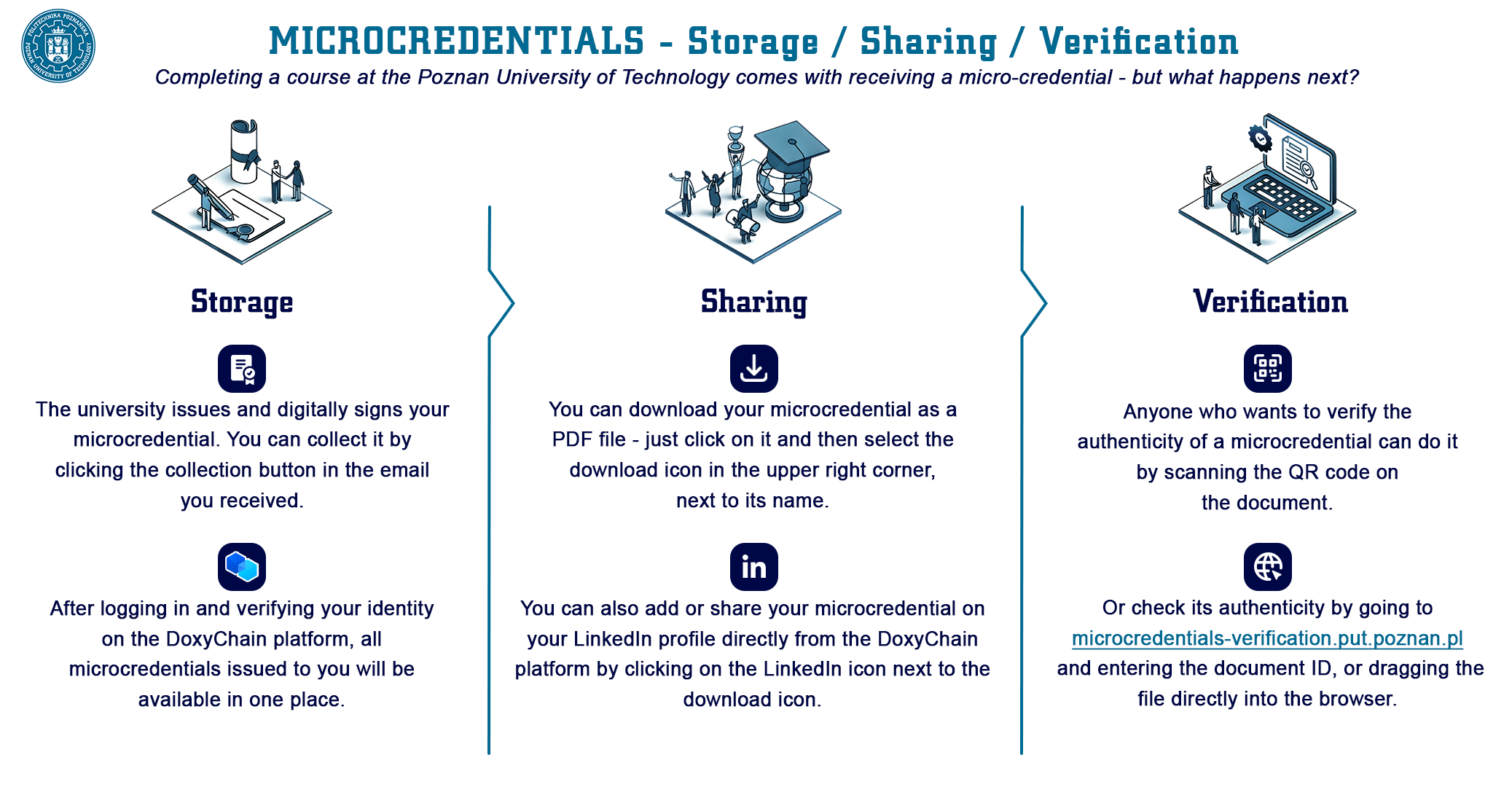
DoxyChain is an advanced platform for managing microcredentials and digital certificates, enabling educational institutions to handle the entire credential lifecycle - from design, issuance and signing, through distribution, to real-time verification and updates. Based on proprietary blockchain technology, the platform transforms traditional documents (e.g. PDFs) into secure, immutable digital assets with unique identifiers, which can be independently verified without the involvement of the issuing institution. It provides full control over data and metadata, allows microcredentials to be tailored to specific learning outcomes, and supports their modular, stackable structure in line with European standards. By using a hybrid blockchain network, DoxyChain ensures the highest levels of security, transparency and resistance to fraud, while enabling instant verification (e.g. via QR code) and storage of credentials in users’ digital wallets. As a result, DoxyChain supports universities in scalable implementation of microcredentials, increasing their credibility, portability and recognition within the European and global education ecosystem and labour market. |
The implementation of DoxyChain at Poznan University of Technology marks an important step towards the digitalisation of educational and administrative processes. The platform also simplifies document management - allowing the university to quickly issue, update or revoke credentials, while students and training participants gain clear digital access to their achievements. This solution strengthens trust in issued certificates, facilitates international mobility, and aligns with European standards in digital education and micro-credentials. |